Continental Drift - History Of Wegener's Theory, Evidence Of The Theory, Formation Of Pangaea, Pangaea Splits
crust continents mantle oceanic
The relative movement of the continents is explained by modern theories of plate tectonics. The relative movement of continents is explained by the movement
Diagram illustrating formation of continental margins. (a) Materials in Earth's mantle move up (often through volcanos) expanding the continental crust and causing rifting. (b) As it divides, the continental crust thins, and continues to separate. (c) New oceanic crust forms from the mantle materials that have surfaced. (d) The oceanic crust is further widened by sea floor spreading. Illustration by Argosy. The Gale Group.
of lithospheric plates—of which the visible continents are a part—over the athenosphere (the molten, ductile, upper portion of Earth's mantle). In a historical sense, the now discarded explanations of continental drift were rooted in antiquated concepts regarding Earth's structure.
Explanations of continental drift that persisted well into the twentieth century made the improbable geophysical assertion that the continents moved through and across an underlying oceanic crust much as ice floats and drifts through water. Eventually multiple lines of evidence allowed modern tectonic theory to replace continental drift theory.
In the 1920s, German geophysicist Alfred Wegener's writings advanced the hypothesis of continental drift depicting the movement of continents through an under-lying oceanic crust.
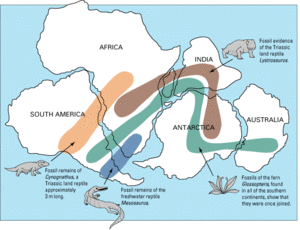
Wegner's hypothesis met with wide skepticism but found support and development in the work and writings of South African geologist Alexander Du Toit who discovered a similarity in the fossils found on the coasts of Africa and South America that were seemingly derived from a common source. Other scientists also attempted to explain orogeny (mountain building) as resulting from Wegner's continental drift.
Technological advances necessitated by the Second World War made possible the accumulation of significant evidence regarding Wegener's hypothesis, eventually refining and supplanting Wegner's theory of continental drift with modern plate tectonic theory. Although Wegener's theory accounted for much of the then existing geological evidence, Wegener's hypothesis was specifically unable to provide a verifiable or satisfying mechanism by which continents—with all of their bulk and drag—could move over an underlying mantle that was solid enough in composition to be able to reflect seismic S-waves.
Additional Topics
At one time—estimated to be 200 to 300 million years ago—continents were united in one supercontinent or protocontinent named Pangaea (or Pangea, from the Greek pan, meaning all, and gaea, meaning world) that first split into two halves. The two halves of the protocontinent were the northern continent Laurasia and the southern continent named Gondwanaland or Gondwana. These two piece…
Technological improvements after World War II supported many of Wegener's ideas about continental drift. New methods of dating and drilling for rock samples, especially from deep-sea drilling ships like the Glomar Challenger, have allowed more precise matching of Pangaea's rocks and fossils. Data from magnetometers (instruments that measure the magnetism of the iron in sea floor rock…
With improved technology, geologists have taken the Continental Drift theory back in time to 1,100 million years ago (Precambrian geologic time) when another supercontinent had existed long before Pangaea. This supercontinent named Rodinia split into the two half-continents that moved far apart to the north and south extremes of the planet. About 514 million years ago (in the late Cambrian), Laura…
During the formation of Pangaea, the collision of North America and northwestern Africa uplifted a mountain range 621 mi (1,000 km) long and as tall as the Himalayas, the much-eroded roots of which can still be traced from Louisiana to Scandinavia. The Appalachians are remnants of these mountains, the tallest of which centered over today's Atlantic Coastal Plain and over the North American …
Citing this material
Please include a link to this page if you have found this material useful for research or writing a related article. Content on this website is from high-quality, licensed material originally published in print form. You can always be sure you're reading unbiased, factual, and accurate information.
Highlight the text below, right-click, and select “copy”. Paste the link into your website, email, or any other HTML document.
User Comments
about 1 year ago
bob
bad!!!!!!!!!!!!!!!!!!!!!!!!!!!!!!!!!!!!!!!!!!!!!!!!!!!!!!!!!!!!!!!!!!!!!!!!!!!!!!!!!!!!!!!!!!!!!!!!!!!!!!!!!!!!!!!!!!!!!!!!!!!!!!!!!!!!!!!!!!!!!!
almost 4 years ago
why did the theory of continental drift die at one point?
7 months ago
wew!!!!!.....it helps me to expand my knowlegde...tnx!!!!
10 months ago
Awesomeness
JkjkjkjkjkjkjkjkjkjkjkjkjkjkjkjkjkjkjkjkjkjkjkjkjkjkjkjkhahahahahahahahahahahahahahahahahahHHhHh
over 1 year ago
Mysterious chick
because it was filled with christian people and churches were even more powerful than kings. they didn't believe that the lands moved because 'god' created everything and also moving land was not possible.
7 months ago
wew!!!!!.....it helps me to expand my knowlegde...tnx!!!!