Cell - Types Of Cells, Prokaryotes And Eukaryotes, Cell Size And Numbers, The Structure And Function Of Cells - The structure of eukaryotes, Plant organelles, Vacuoles, Cell wall
membrane —the nucleus plasma
The cell is the smallest living component of organisms and is the basic unit of life. In multicellular living things, a collection of cells that work together to perform similar functions is called a tissue; various tissues that perform coordinated functions form organs; and organs that work together to perform general processes form body systems. The human digestive system, for example, is composed of various organs including the stomach, pancreas, and the intestines. The tissue that lines the intestine is called epithelial tissue. Epithelial tissue, in turn, is composed of special cells called epithelial cells. In the small intestine, these epithelial cells are specialized for their absorptive function: each epithelial cell is covered with thousands of small projections called microvilli. The numerous microvilli greatly increase the surface area of the small intestine through which nutrients can be absorbed into the bloodstream.
The organelles found in eukaryotes include the membrane system consisting of plasma membrane, endoplasmic reticulum, Golgi body, and vesicles; the nucleus; cytoskeleton; and mitochondria. In addition, plant cells have special organelles not found in animals cells. These organelles are the chloroplasts, cell wall, and vacuoles.
Plant cells have several organelles not found in animal cells. These are plastids, vacuoles, and a cell wall.
Plant vacuoles are large vesicles bound by a single membrane. In many plant cells, they occupy about 90% of the cellular space. They perform a variety of functions in the cell, including storage of organic compounds, waste products, pigments, and poisonous compounds, as well as digestive functions.
All plant cells have a cell wall that overlies the plasma membrane. The cell wall of plants consists of a tough carbohydrate substance called cellulose laid down in a matrix or network of other carbohydrates. The cell wall provides an additional layer of protection between the contents of the cell and the outside environment. The crunchiness of an apple, for instance, is attributed to the presence of these cell walls.
Resources
Books
Barritt, Greg J. Communication within Animal Cells. Oxford: Oxford University Press, 1992.
Bittar, F. Edward, ed. Chemistry of the Living Cell. Greenwich, CT: JAI Press, 1992.
Bray, Dennis. Cell Movements. New York: Garland Press, 1992.
Carroll, Mark. Organelles. New York: Guilford Press, 1989. The Cell Surface. Plainview, NY: Cold Spring Harbor Laboratory Press, 1992.
Periodicals
Maddox, John. "Why Microtubules Grow and Shrink." Nature 362 (March 18, 1993): 201.
Pante, Nelly, and Ueli Aebi. "The Nuclear Pore Complex." The Journal of Cell Biology 122 (September 1993): 5-6.
Scott, J. D. and T. Pawson. "Cell Communication: The Inside Story." Scientific American 282 (June 2000): 54-61.
Shay, Jerry W., and Woodring E. Wright. "Hayflick, His Limit, and Cellular Aging." Nature Reviews/Molecular Cell Biology (October 1, 2000): 72-76.
Additional Topics
Multicellular organisms contain a vast array of highly specialized cells. Plants contain root cells, leaf cells, and stem cells. Humans have skin cells, nerve cells, and sex cells. Each kind of cell is structured to perform a highly specialized function. Often, examining a cell's structure reveals much about its function in the organism. For instance, as we have already seen, epithelial cel…
It is estimated that an adult human body contains about 60 trillion cells. Most of these cells, with some exceptions, are so small that a microscope is necessary to see them. The small size of cells fulfills a distinct purpose in the functioning of the body. If cells were larger, many of the processes that cells perform could not occur efficiently. To visualize this concept, think about the intest…
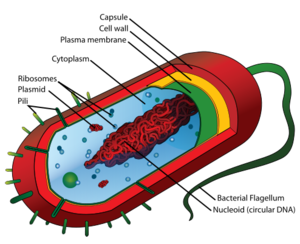
An example of a typical prokaryote is the bacterial cell. Bacterial cells can be shaped like rods, spheres, or corkscrews. All prokaryotes are bounded by a plasma membrane. Overlying this plasma membrane is a cell wall, and in some bacteria, a capsule consisting of a jelly-like material overlies the cell wall. Many bacteria that cause illness in animals have capsules. The capsule provides an extra…
The plasma membrane of the cell is often described as "selectively permeable;" that is, the plasma membrane is designed so that only certain substances are allowed to traverse its borders. The plasma membrane is composed of two layers of molecules called phospholipids. Each phospholipid molecule consists of a phosphate "head" and two fatty acid chains that dangle from t…
The endoplasmic reticulum (meaning "within the cytoplasm" and "net") consists of flattened sheets, sacs, and tubes of membrane that cover the entire expanse of a eukaryotic cell's cytoplasm. This internal system of membrane is continuous with the double membrane that surrounds the cell's nucleus. Therefore, the encoded instructions that the nucleus sends o…
Named for its discoverer, nineteenth century Italian scientist Camillo Golgi, the Golgi body is one of the most unusually shaped organelles. Looking somewhat like a stack of pancakes, the Golgi body consists of stacked, membrane-bounded, flattened sacs. Surrounding the Golgi body are numerous, small, membrane-bounded vesicles. The Golgi body and its vesicles function in the sorting, modifying, and…
Vesicles are small, membrane-bounded spheres that contain various macromolecules. Some vesicles, as we have seen, are used to transport macromolecules from the endoplasmic reticulum to the Golgi body, and from the Golgi body to various destinations. Special kinds of vesicles perform other functions as well. Lysosomes are vesicles that contain enzymes involved in cellular digestion. Some protists, …
The nucleus is the control center of the cell. Under a microscope, the nucleus looks like a dark blob, with a darker region, called the nucleolus, centered within it. The nucleolus is the site where the subunits of ribosomes are manufactured. Surrounding the nucleus is a double membrane called the nuclear envelope. The nuclear envelope is studded all over with tiny openings called nuclear pores. T…
The cytoskeleton is the "skeletal" framework of the cell. Instead of bone, however, the cell's skeleton consists of three kinds of protein filaments that form networks. These networks give the cell shape and provide for cellular movement. The three types of cytoskeletal fibers are microtubules, actin filaments, and intermediate filaments. Microtubules are 25 nanometers in diam…
The mitochondria are the power plants of cells. Each sausage-shaped mitochondrion is covered by an outer membrane; the inner membrane of a mitochondrion is folded into compartments called cristae (meaning "box"). The matrix, or inner space created by the cristae, contains the enzymes necessary for the many chemical reactions that eventually transform food molecules into energy. Cells…
Plastids are vesicle-type organelles that perform a variety of functions in plants. Amylopasts store starch, and chromoplasts store pigment molecules that give some plants their vibrant orange and yellow colors. Chloroplasts are plastids that carry out photosynthesis, a process in which water and carbon dioxide are transformed into sugars. The interior of chloroplasts contains an elaborate membran…
User Comments
about 2 years ago
lisa
its helps but its not that specific with the structure/functions of the cell organelles...needs to say if its found in both of plant and animals and thoguh science is complicated make the definations in an easy way not that scientific.
10 months ago
hi
10 months ago
hi\
afa
fsfa
about 1 year ago
this is a good work.
about 1 year ago
this is a good work.