A generator is a machine by which mechanical energy is transformed into electrical energy. Generators can be sub-divided into two major categories depending on whether the electric current produced is alternating current (AC) or direct current (DC). The basic principle on which both types of generator works is the same, although the details of construction of the two may differ somewhat. Generators can also be classified according to the source of the mechanical power (or prime mover) by which they are driven, such as water or steam power.
The scientific principle on which generators operate was discovered almost simultaneously in about 1831 by the English chemist and physicist, Michael Faraday, and the American physicist, Joseph Henry. Imagine that a coil of wire is placed within a magnetic field, with the ends of the coil attached to some electrical device, such as a galvanometer. If the coil is rotated within the magnetic field, …
In an electrical generator, the galvanometer mentioned above would be replaced by some electrical device. For example, in an automobile, electrical current from the generator is used to operate headlights, the car radio, and other electrical systems within the car. The ends of the coil are attached not to a galvanometer, then, but to slip rings or collecting rings. Each slip ring, in turn, is atta…
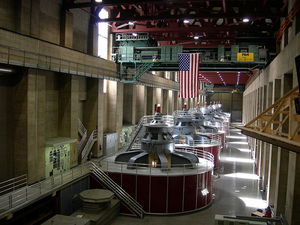
One of the most important practical applications of generators is in the production of large amounts of electrical energy for industrial and residential use. The two most common prime movers used in operating AC generators are water and steam. Both of these prime movers have the ability to drive generators at the very high rotational speeds at which they operate most efficiently, usually no less t…
An AC generator can be modified to produce direct current (DC) electricity also. The change requires a commutator. A commutator is simply a slip ring that has been cut in half, with both halves insulated from each other. The brushes attached to each half of the commutator are arranged so that at the moment the direction of the current in the coil reverses, they slip from one half of the commutator…
Citing this material
Please include a link to this page if you have found this material useful for research or writing a related article. Content on this website is from high-quality, licensed material originally published in print form. You can always be sure you're reading unbiased, factual, and accurate information.
Highlight the text below, right-click, and select “copy”. Paste the link into your website, email, or any other HTML document.
earth has magnetic field. can it used to generate electricity?
11 months ago
nice
8 months ago
Maya
Interested to know about EFM.
10 months ago
Generator - Principle Of Operation, Alternating Current (ac) Generators, Commercial Generators, Direct Current (dc) Generators
11 months ago
chidambaranadhan
dg operator
12 months ago
very use full website
about 1 year ago
i want a 3phase and singe generator operation princepile
about 1 year ago
while connecting the DG with 100A load for testing purpose.the Dg is not withstanding the starting up load due to which vector error is coming(Phase angle difference).The GD capacity is 625kva and it could withsatand 850A load.But its not withstand for 100A its self that is about only 10% of load.
Can you give me the solution how to over come this problum and if their any testings or alternatives please say me.
about 1 year ago
ashraf
closed
16 days ago
fantastic definition...
7 months ago
very nice
7 months ago
penchalaiah
hai i am interested to make generater so plz inform me what is necessary materials and how it should made.
I would like to know more about working priciple of a generator and the generator coil.
12 months ago
how can make a useful transformer
about 1 year ago
want to get more on working principle of generator, i am engineer in electricity
about 1 year ago
difference between ac and dc generator
about 1 year ago
khashllhalghlhlkl
hlasghl
asghklk
about 1 year ago
generator
about 1 year ago
durgaprasad
generator
about 1 year ago
durgaprasad
generator
about 1 year ago
durgaprasad
generator
over 1 year ago
farhan
An electrical Generator is a machine which converts mechanical energy (or power) into electrical energy (or power).
Principle :
It is based on the principle of production of dynamically (or motionally) induced e.m.f (Electromotive Force). Whenever a conductor cuts magnetic flux, dynamically induced e.m.f. is produced in it according to Faraday's Laws of Electromagnetic Induction. This e.m.f. causes a current to flow if the conductor circuit is closed.
Hence, the basic essential parts of an electric generator are :
A magnetic field and
A conductor or conductors which can so move as to cut the flux.
over 1 year ago
pls give me rating of commercial generator & its actual function/ actual process between generator start to stop.(how generator make electrical energy)
over 1 year ago
can i attach a moter to a alternater so that agenretor give astart energy to rotate and then the moter use the electrical energy produced.
User Comments
about 1 year ago
durgaprasad
generator
almost 2 years ago
earth has magnetic field.
can it used to generate electricity?
11 months ago
nice
8 months ago
Maya
Interested to know about EFM.
10 months ago
Generator - Principle Of Operation, Alternating Current (ac) Generators, Commercial Generators, Direct Current (dc) Generators
11 months ago
chidambaranadhan
dg operator
12 months ago
very use full website
about 1 year ago
i want a 3phase and singe generator operation princepile
about 1 year ago
while connecting the DG with 100A load for testing purpose.the Dg is not withstanding the starting up load due to which vector error is coming(Phase angle difference).The GD capacity is 625kva and it could withsatand 850A load.But its not withstand for 100A its self that is about only 10% of load.
Can you give me the solution how to over come this problum and if their any testings or alternatives please say me.
about 1 year ago
ashraf
closed
16 days ago
fantastic definition...
7 months ago
very nice
7 months ago
penchalaiah
hai i am interested to make generater so plz inform me what is necessary materials and how it should made.
8 months ago
HANUCHAND
no matterrrrrrrrrrrrrrrrrr
8 months ago
lekan
short
8 months ago
nice
8 months ago
nice
10 months ago
nice
11 months ago
http://www.youtube.com/watch?feature=player_embedded&v=k7Sz8oT8ou0
11 months ago
nice
11 months ago
nice
11 months ago
nice
11 months ago
cost of genreted
& shop in solapur
11 months ago
I would like to know more about working priciple of a generator and the generator coil.
12 months ago
how can make a useful transformer
about 1 year ago
want to get more on working principle of generator, i am engineer in electricity
about 1 year ago
difference between ac and dc generator
about 1 year ago
khashllhalghlhlkl
hlasghl
asghklk
about 1 year ago
generator
about 1 year ago
durgaprasad
generator
about 1 year ago
durgaprasad
generator
about 1 year ago
durgaprasad
generator
over 1 year ago
farhan
An electrical Generator is a machine which converts mechanical energy (or power) into electrical energy (or power).
Principle :
It is based on the principle of production of dynamically (or motionally) induced e.m.f (Electromotive Force). Whenever a conductor cuts magnetic flux, dynamically induced e.m.f. is produced in it according to Faraday's Laws of Electromagnetic Induction. This e.m.f. causes a current to flow if the conductor circuit is closed.
Hence, the basic essential parts of an electric generator are :
A magnetic field and
A conductor or conductors which can so move as to cut the flux.
over 1 year ago
pls give me rating of commercial generator & its actual function/ actual process between generator start to stop.(how generator make electrical energy)
over 1 year ago
can i attach a moter to a alternater so that agenretor give astart energy to rotate and then the moter use the electrical energy produced.